
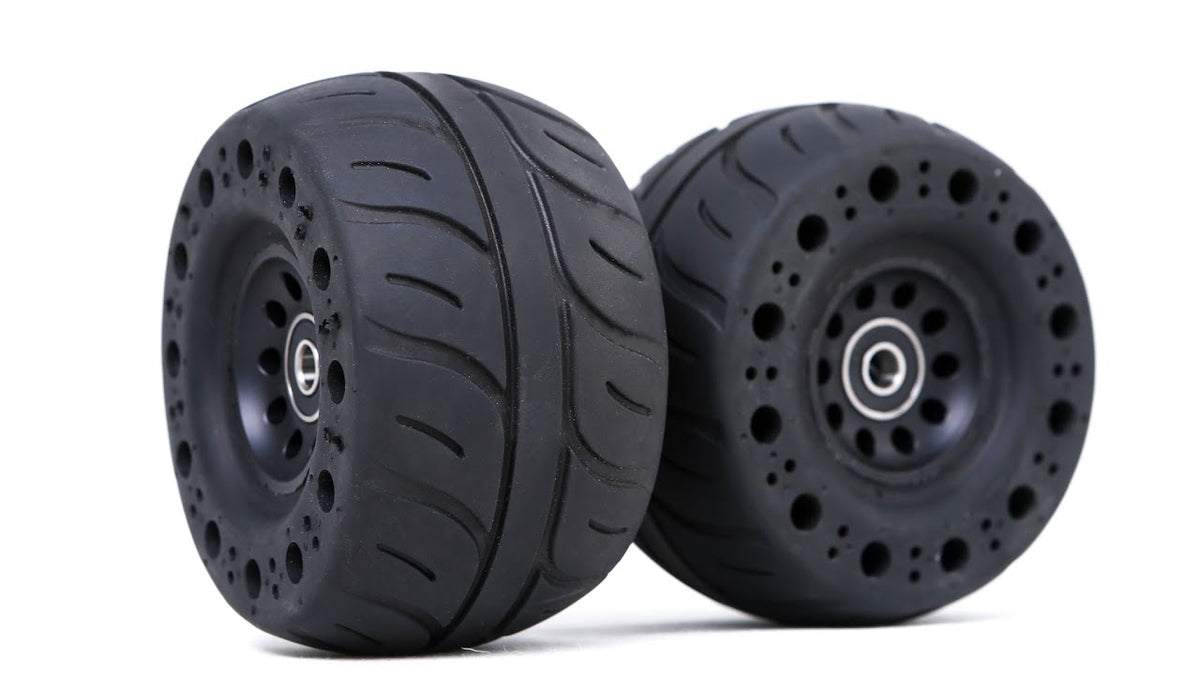
Wheels change how an electric skateboard feels more than almost any other part. The same board can feel nervous and buzzy, or calm and planted, just by changing what touches the road. This guide explains the three main types of electric skateboard wheels (polyurethane, rubber and pneumatic), how size, width and durometer change the ride, what our own tests showed, and which wheel fits which ONSRA board.
The three types of electric skateboard wheels
Polyurethane (PU) street wheels
PU (urethane) wheels are what most skateboards and longboards roll on. They are solid, light, efficient and precise. On electric boards they usually measure about 75 to 110 mm. Their weakness is vibration: a hard PU wheel passes every crack and rough patch of asphalt straight into your feet.
Our 100 mm TARMAX is a PU wheel built to soften that trade-off (more below). The ZENO's hub motors use our own 75 mm PU wheels.
Rubber wheels
Rubber street wheels are still solid, but the softer compound deforms more on rough surfaces. That gives a noticeably smoother, quieter ride and more grip, at the cost of some range. Our 115 mm rubber wheels are 65 mm wide with a 70A durometer, and they come stock on the BLACK Carve 4 Street.
Pneumatic (air-filled) tires
Pneumatic tires use an inner tube (or a tubeless tire) on a hub, usually in 150 to 200 mm sizes. The air cushion absorbs bumps that no solid wheel can, and the tread grips on gravel and dirt. The downsides are weight, rolling resistance, a higher deck and possible flats. They're standard on all-terrain boards like the VELAR 2.0 and the Challenger 2.0 AT.
What about cloud wheels?
"Cloud wheels" usually means Cloudwheel, a third-party brand ONSRA doesn't sell. According to the manufacturer, models like the Rovers combine a foam core and urethane with a bonded rubber tread. The wheel flattens slightly under load and springs back, which damps vibration, and it can't go flat. In the cloud wheels vs pneumatic question, they sit in between: more comfortable than standard PU and puncture-proof, but they can't match the air volume and ground clearance of a real 150 to 200 mm pneumatic tire on rough trails.

Electric skateboard wheel size, width and durometer
Three numbers describe a solid wheel: diameter, width (contact patch) and durometer (hardness).
Diameter. Bigger wheels roll over cracks and small stones instead of catching on them, and they feel smoother. They also raise the deck and act like a taller gear: same motor, higher top speed, less pull. Smaller wheels accelerate harder, keep the board lower and weigh less.
Width. A wider contact patch means more grip and stability, especially when braking and carving. Our 115 mm rubber wheel is 65 mm wide. The TUOVT racing tire uses a 55 mm wide footprint precisely to maximise braking and corner grip.
Durometer. Wheel hardness is measured on the Shore A scale. A lower number means softer: more grip and comfort, a bit more rolling resistance. A higher number means harder: faster rolling, more vibration and less grip. Most electric skateboard street wheels sit roughly between 70A and 80A. For reference:
- 115 mm rubber: 70A (softest, most comfort)
- TARMAX 100 mm: 76A on the inside, 72A on the outside edge
So which electric skateboard wheel size should you pick? For smooth bike paths and city carving, 90 to 100 mm PU is light and efficient. For mixed city asphalt with cracks, a large soft street wheel around 110 to 115 mm is the comfort sweet spot. For gravel, dirt and really broken roads, go pneumatic at 150 mm or more.
Rubber vs PU: what our tests showed
Rubber wheels on an electric skateboard are ONSRA's most-watched wheel topic for a reason. In our rubber wheel test, filmed with a two-microphone camera so you can actually hear the difference, the 70A rubber wheels stayed quiet and smooth on asphalt so rough you would normally slow right down. Fabian's verdict: they are not off-road wheels, they are simply the smoothest street wheels we have ridden.
Three findings from that test still hold:
- Comfort costs range. We measured roughly 20 to 30% less range than with PU wheels. Rider weight matters a lot: one 120 kg customer reported 15 to 16 km per charge. That's why we offer different wheel options instead of one wheel for everyone.
- Size matters for comfort. A soft compound on a small 100 mm wheel would not feel the same. The large diameter is part of why these wheels roll so smoothly.
- They last. After about 70 km, the motor-side wheels showed barely any wear, a big step up from the wheels we had a year earlier.
We later put the 115 mm rubber wheels on a VELAR prototype and rode it up a Ticino mountain road on rough, patched asphalt, with nimble truck settings, deep carves and even donuts. The low ride height felt great, and the only limit was clearance on big bumps. For that setup, a 5 to 6 mm riser pad would have been ideal. This was a prototype test, not a current VELAR 2.0 or VELAR 2.0 S setup: today's boards ship on 200 mm pneumatic all-terrain tires. There's also a short clip of the turning radius on 115 mm rubber.
TARMAX: PU with a range-and-grip trick
The TARMAX is a 100 mm dual-durometer PU wheel. The inner part is 76A for efficiency, the outer edge 72A for grip. The outside is also 2 mm smaller in diameter than the inside. When you ride straight and fast, you roll mostly on the harder inner section, which helps range. When you lean into a carve, the softer outer edge bites. It's still smooth on rough roads, though not quite as soft as the 70A rubber wheel, and it can be slid once you get the technique. We tested TARMAX prototypes for about seven months before release. It's the stock wheel on the Challenger 2.0 Street.
On a low VELAR prototype, 100 mm wheels show the other side of small wheels: the board sits very close to the ground and carves hard, but the deck sits so close to the road that it can scrape in deep carves. Again, this was a prototype test and not a current VELAR 2.0 configuration.
When to go pneumatic
Choose air-filled tires when your rides include gravel, dirt, grass, cobblestones or seriously broken roads, or when comfort beats everything else. Typical sizes:
- 150 mm: the classic all-terrain size. Light, affordable, a big comfort jump over any solid wheel.
- 155 mm Gen 3 HOTA: made for smooth street riding with confidence on light off-road. A 150 mm tube is recommended (max 45 PSI / 3 bar).
- 155 mm new-generation HOTA: 7.5 mm sidewalls and an 8 mm tread. You can keep riding home even if the tube fails (Flat? Keep Going!).
- 165 mm heavy duty: thick sidewalls for rough terrain, max 50 PSI.
- 200 mm and 200 × 75 mm: maximum comfort and clearance. The KG USA 200 × 75 mm tire fits the VELAR 2.0's 57 mm CNC hubs.
- TUOVT 160 × 55 mm: a pneumatic tire for street racing, not comfort. It has a nylon-reinforced structure, runs at 36 to 60 PSI and needs a 150 mm tube.
Pressure is your tuning knob. Harder tires roll faster and go further; softer tires grip better and feel more comfortable. Never exceed the maximum printed on the sidewall.
Fixing a flat
A flat is the price of air. On ONSRA AT wheels you split the hub by removing five screws, swap the tube, reassemble and pump it up. Watch the full process below, and check tire pressure before every ride. More in our maintenance guide.
How wheels change range and speed
Wheels change both the energy you need and the effective gearing.
- Range: softer and wider wheels mean more rolling resistance and less range. Our 70A rubber wheels cost roughly 20 to 30% compared with PU. Pneumatic tires cost more again, and low pressure costs most. More in our range guide.
- Top speed: a bigger wheel covers more ground per motor turn. On our AT tire chart for the BLACK Carve 3, 150 mm tires give 44 km/h and 200 mm tires 59 km/h with the same 60T pulleys. The BLACK Carve 4's spec sheet lists 62 km/h on the stock 115 mm wheels and 85 km/h with 165 mm tires.
- Acceleration and hills: the flip side. Bigger wheels on the same gearing pull less hard. Adjust the pulley to compensate: a bigger motor pulley gives more acceleration, a smaller one more top speed.
Compatibility: cores, pulleys, hubs and bearings
Before you order new wheels, check four things:
- Core and drive. Belt-drive street wheels need a matching wheel pulley, usually Kegel or ABEC. Our pulleys come in 32T, 40T and 45T Kegel and 40T and 45T ABEC. The 115 mm rubber wheels fit Kegel setups on the BLACK Carve 1 to 4, all Challenger generations, direct drives with Kegel adapters and street gear drives with a Kegel adapter (BLACK Carve 4 Street).
- Hubs for pneumatic tires. Plastic AT hubs take our 150 mm and 200 mm tires with 60T or 66T AT pulleys. CNC aluminium hubs come in 46 mm (10 mm axles, BC3 / BC3 PRO) and 57 mm (12 mm axles, VELAR 2.0 and suspension trucks). Gear drives on CNC hubs use the CNC hub adapter.
- Axles and current VELAR models. The current VELAR 2.0 and VELAR 2.0 S are set up for 200 mm pneumatic tires. Please contact us before fitting any other wheel.
- Bearings. 8 mm or 10 mm axles need matching bearings. Our 115 mm rubber and TARMAX sets come with bearings, and our bearing sets cover both.
Hub-motor boards such as the ZENO only take wheels and sleeves made for that motor. Changing to bigger wheels also changes your gearing, so you may want a different pulley.

Which wheel for which ONSRA board
Prices are in CHF from onsra.ch.
| Board | Stock wheels | Good alternatives |
|---|---|---|
| BLACK Carve 4 Street (CHF 1,990) | 115 × 65 mm rubber, 70A | Other Kegel street wheels via the Kegel adapter |
| BLACK Carve 4 AT (CHF 2,090) | Pneumatic all-terrain tires | Spec sheet quotes 85 km/h with 165 mm tires |
| Challenger 2.0 Street (CHF 1,440) | 100 mm TARMAX (76A / 72A) | 115 mm rubber for more comfort |
| Challenger 2.0 AT (CHF 1,490) | HOTA pneumatic tires | Gen 3 HOTA tires (more street grip) |
| VELAR 2.0 Gear Drive (CHF 2,690) | 200 mm pneumatic AT | KG USA 200 × 75 mm for more comfort |
| VELAR 2.0 S (CHF 2,990) | 200 × 75 mm pneumatic AT | KG USA 200 × 75 mm replacement tires (tube required) |
| ZENO (CHF 990) | 75 mm PU hub-motor wheels | ZENO replacement front wheels and sleeves |
The bottom line
The best electric skateboard wheels are the ones that match your roads, not the biggest or softest ones. Smooth roads and long rides call for efficient PU like TARMAX. Rough city asphalt calls for soft, large rubber like our 115 mm 70A. Gravel, dirt and maximum comfort call for pneumatic tires. Whatever you pick, match the pulley and hub, and keep an eye on wear, pressure and bearings. Good wheels also brake better, as explained in How to Stop an Electric Skateboard.
FAQ
What are the best electric skateboard wheels?
It depends on your roads. For smooth pavement and range, a 90 to 100 mm PU wheel such as the ONSRA TARMAX is efficient and precise. For rough city asphalt, large soft rubber wheels like our 115 mm 70A are the smoothest street option. For gravel and dirt, pneumatic tires of 150 mm or more are the right choice.
What size wheels are best for an electric skateboard?
For street riding, 90 to 115 mm covers most needs. Smaller wheels accelerate harder and keep the board low, while larger ones roll over cracks more easily and feel smoother. For off-road riding, 150 to 200 mm pneumatic tires are standard.
Are rubber wheels better than PU wheels on an electric skateboard?
Rubber wheels are smoother, quieter and grippier on rough asphalt. In our test, the 70A rubber wheels gave roughly 20 to 30% less range than PU, and the gap grows with heavier riders. PU wheels roll further and feel more direct.
What does durometer mean on skateboard wheels?
Durometer is the hardness on the Shore A scale. A lower number like 70A is softer: more grip and comfort, slightly less range. A higher number like 78A is harder: faster rolling, but more vibration.

Cloud wheels vs pneumatic: which is better?
Cloud-style wheels (for example Cloudwheel) can't go flat and are more comfortable than normal PU. Pneumatic tires still absorb far more on gravel and trails and give more ground clearance, but they need air checks and can puncture.
Do bigger wheels make an electric skateboard faster?
Yes, on the same gearing. A larger wheel covers more distance per motor turn, so top speed goes up and acceleration goes down. On the BLACK Carve 3 with 60T pulleys, 150 mm tires give 44 km/h and 200 mm tires 59 km/h.
Can I put street wheels on an all-terrain board?
Often yes, but check the drive. Belt-drive boards need the right wheel pulley (Kegel or ABEC). The current VELAR 2.0 and VELAR 2.0 S are set up for 200 mm pneumatic tires, so check with us before fitting street wheels. Hub-motor boards only take wheels made for their motor.
How often should I replace electric skateboard wheels?
Replace them when they are visibly coned or flat-spotted, chunked, or worn unevenly, or when a pneumatic tire's tread is gone. Swap solid wheels around where your drive setup allows, to even out wear, and check tire pressure and bearings regularly.
Share:
Commuting by Electric Skateboard in Switzerland: What's Allowed and Which Board Fits (2026)
Electric Skateboards in Switzerland 2027: What You'll Be Able to Ride